What advertisers expect from their agency
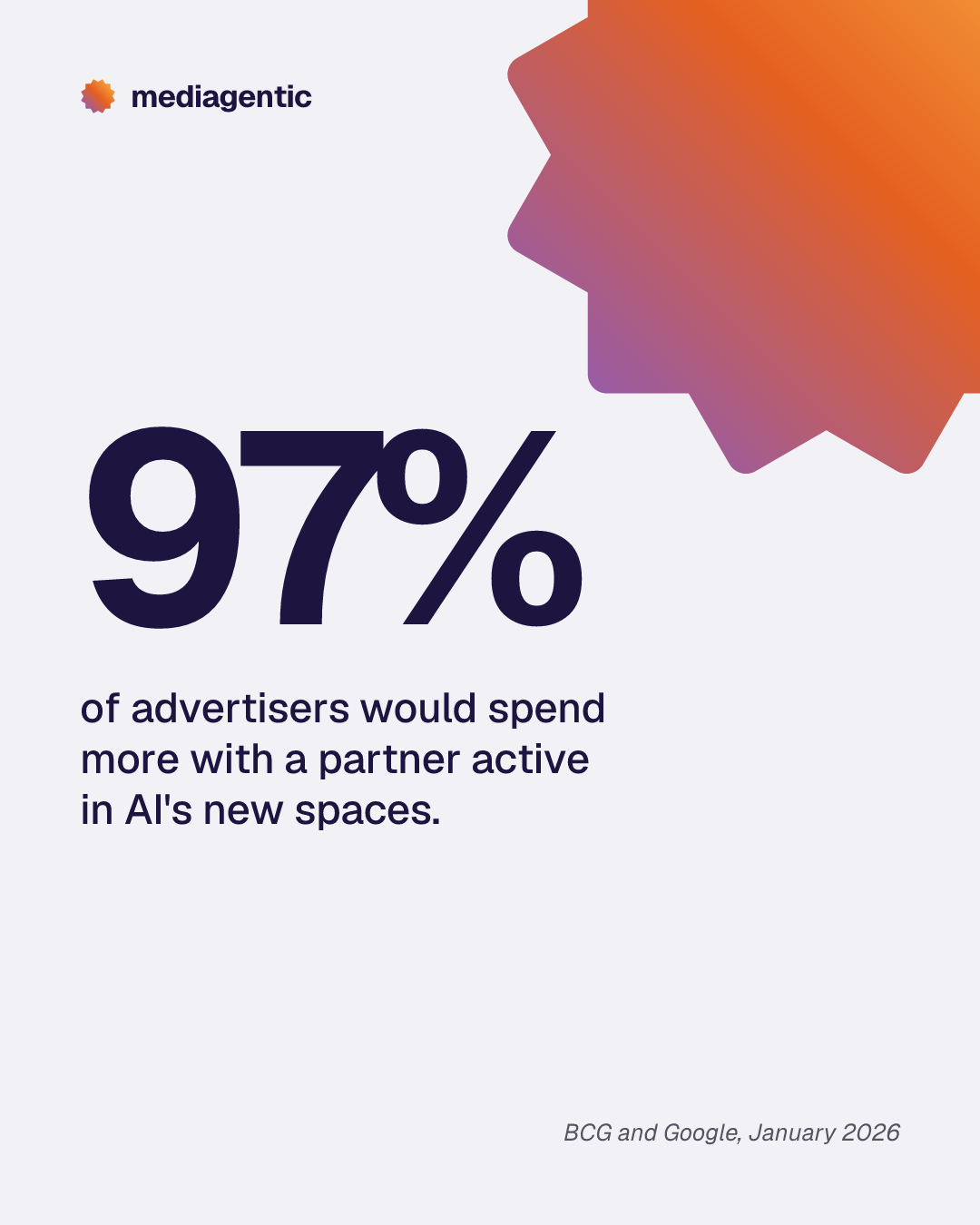
BCG and Google surveyed 387 advertisers about what they expect from their marketing partners. 97% would increase spend with a partner able to support them in the new spaces opened up by AI. Here is how I answer that at mediagentic.
BCG and Google surveyed 387 advertisers in ten countries, including France, in January 2026, about what they expect from their marketing partners. The study is co-signed by Google, which sells some of the tools it discusses, but it makes a useful point: advertisers know what they want and have not found it yet.
97% of them say they would increase spend with a partner able to support them in the new spaces opened up by AI: brand discovery through AI assistants, commerce and buying run by agents, AI-assisted creative and creator marketing. 81% want a partner that integrates creative, media, earned and commerce, and only 45% feel they have one. To assess a partner's AI maturity, they first cite AI expertise (91%), then tool interoperability (77%) and AI integration across processes (75%). Meanwhile, agency recommendations carry less and less weight in their choices: 18% of channel allocation decisions today, 11% expected in two years.
At mediagentic, I built the offer around these expectations, within the scope I cover: paid media, and creative when needed. All your ad accounts (Google, Meta, TikTok, LinkedIn and the others) are connected in one place, with a single media plan and decision rules set once and applied everywhere. Agents execute continuously, and decisions that commit your budget are approved by a human, namely me, something 56% of advertisers list among their priorities.
That leaves compensation. 66% of advertisers would like to pay their partner based on outcomes, and the study acknowledges that these models run into measurement, transparency and risk-sharing issues. I made a different choice: a one-off setup fee, then a fixed monthly fee, both known upfront and with no commission on media, with performance measured through incrementality rather than the ROAS reported by the platforms.
The full study is available on bcg.com.