Google migrated your Search campaigns to AI Max without asking.
In September 2026, every Search campaign using campaign-level broad match or automatically created assets was moved to AI Max: keywordless matching, rewritten headlines, final URL expansion. Without a written plan, Google's recommendation becomes your strategy.
On 11 June 2026, Google confirmed the timeline. Between 1 and 30 September, every Search campaign using campaign-level broad match, or automatically created assets, was switched to AI Max. Creating new campaigns of the old type had been frozen since 3 August. Dynamic Search Ads will follow in February 2027.
AI Max is not a new campaign type: it is an optimisation layer switched on inside your existing campaign. It does three things. Keywordless matching: Google serves your ads on queries none of your keywords cover, based on your site and your ads. Headline rewriting: your headlines are regenerated to fit the query. Final URL expansion: the page served is no longer necessarily the one you chose, but the one Google judges most relevant, which incidentally breaks any reporting join built on the destination URL.
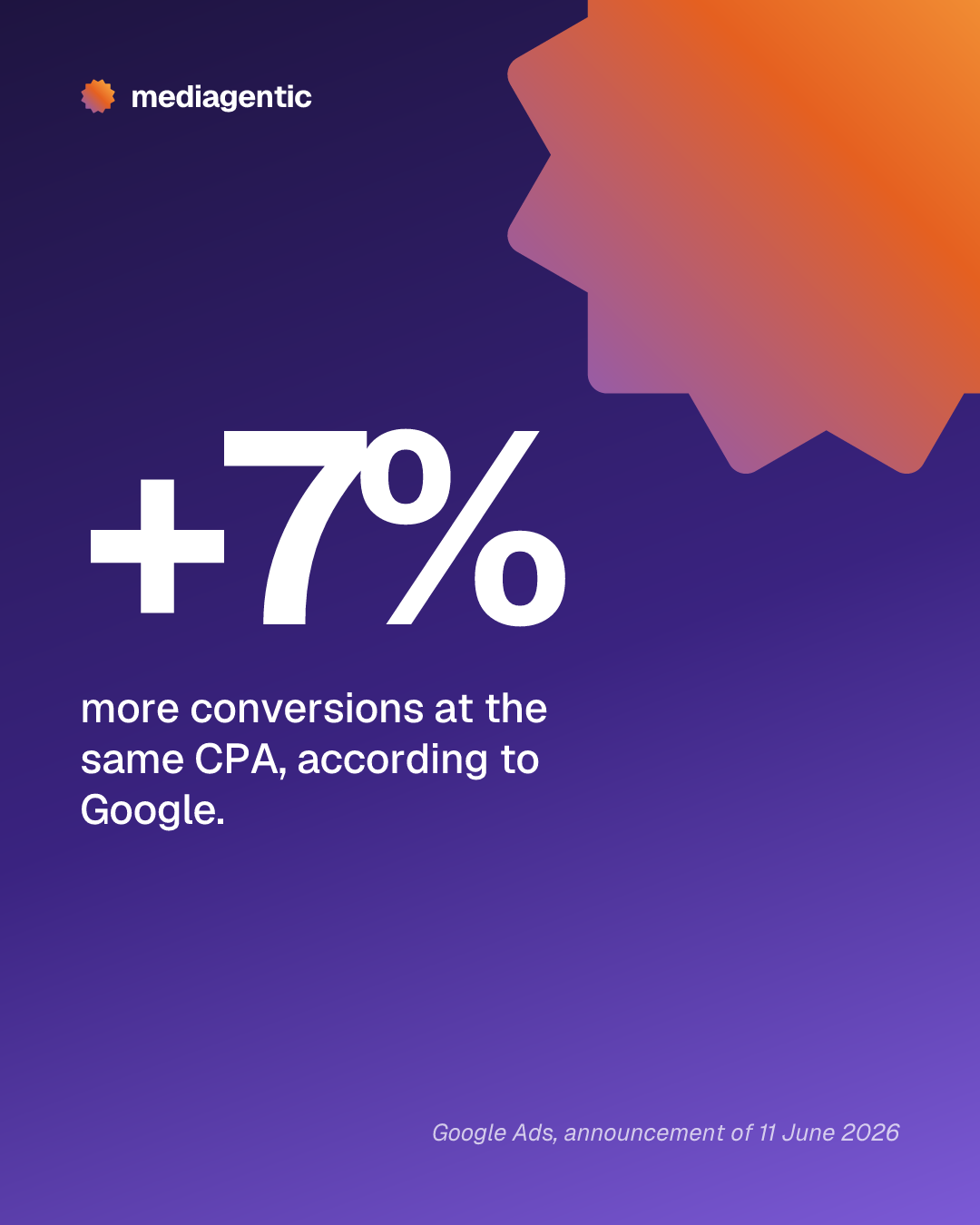
In exchange, a new search_term_match_source segment separates your keywords, broad match expansion and keywordless matching. Google also reports an average of "7% more conversions at a similar CPA" when all three features are switched on: that is the vendor's number, drawn from its internal data.
None of this is bad in itself. What is bad is having it done to you. Without brand controls, AI Max cannibalises your brand search. Without URL exclusions, it sends traffic to pages you never planned for. Without a written objective, it optimises towards what Google can measure (the click, the platform conversion), not towards what you want to achieve.
At mediagentic: a recommendation built on your numbers, written across platforms, to tell AI Max what it is allowed to do.