Operations to agents. Strategy to humans.
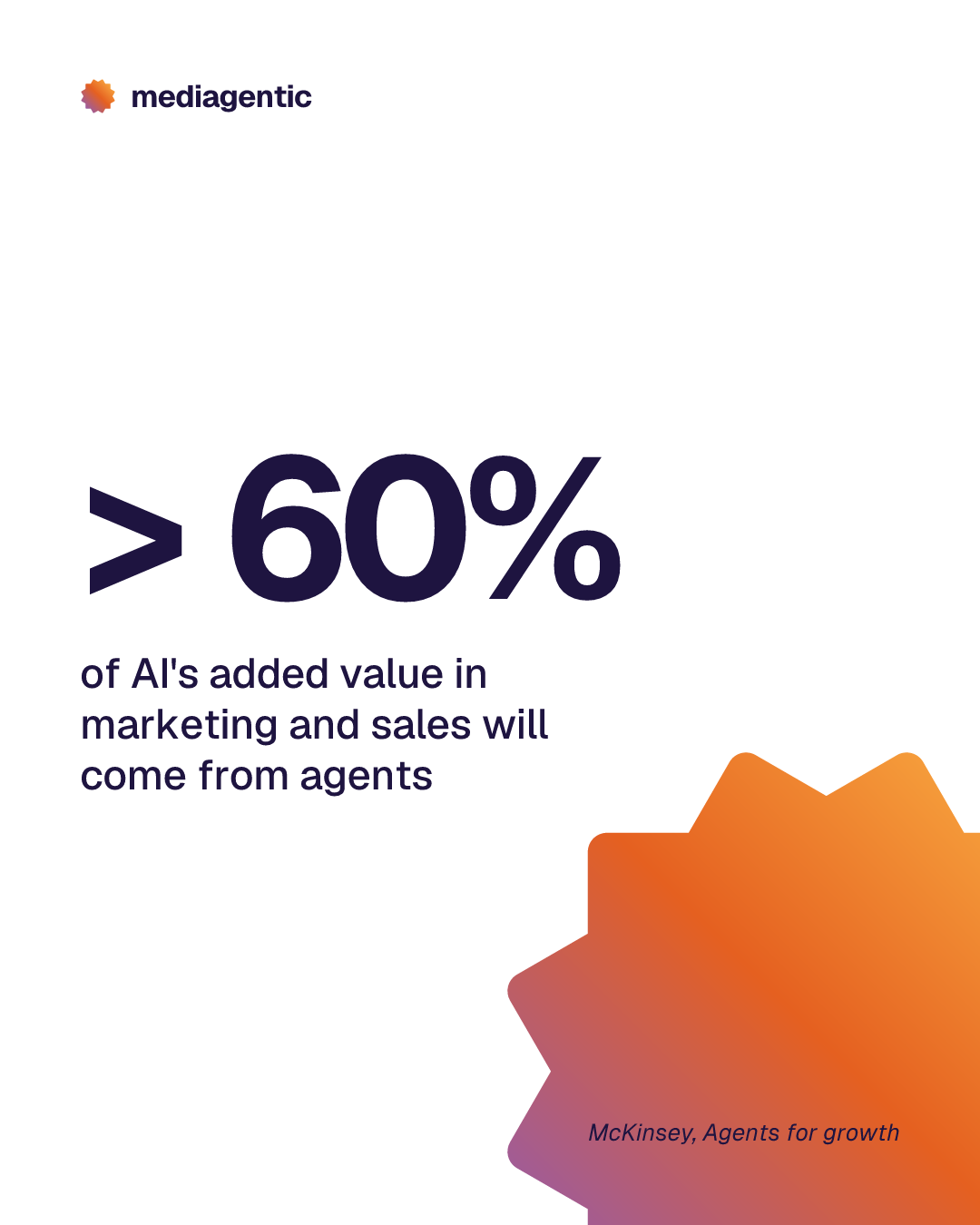
The dividing line isn't “what can be automated”: whatever doesn't depend on the size of the budget goes to agents, whatever requires experience stays human. McKinsey estimates agents will carry more than 60% of AI's added value in marketing and sales.
The debate “will AI replace agencies?” is badly framed. The right question is: in a campaign, what depends on experience, and what doesn't? Everything that doesn't can go to agents. Everything that does stays human.
To agents: building and maintaining Performance Max asset groups and their search themes; managing negative keyword lists, up to 10,000 per campaign; consolidating Meta accounts along practitioners' 2026 benchmark — one or two Advantage+ Sales campaigns for prospecting, one manual retargeting campaign, six to eight active ad sets in total; the daily check of the Conversions API, without which the browser pixel captures only a fraction of events; automated pause and reallocation rules; reporting produced continuously, channel by channel, without waiting for the monthly review.
To humans: the channel mix — how much to Google, how much to Meta, how much to TikTok, how much to nothing; budget arbitration between platforms, which each of them is structurally unable to do for you; brand-safety and exclusion rules, written once; creative direction; and the decision to stop a campaign the platform still rates as excellent.
McKinsey puts a number on it: agentic AI will carry more than 60% of the additional value AI is expected to generate in marketing and sales, and some Fortune 250 companies have accelerated campaign creation and execution fifteenfold. The same report notes that nearly eight organisations in ten still see no net gain — the ones automating without moving the judgment.
That's mediagentic's architecture: expertise on one side, agents on the other; with a virtuous business model where perceived value and created value finally meet.
Book a call
Contact us