Adopting AI agents means rebuilding your organization. I started without one.
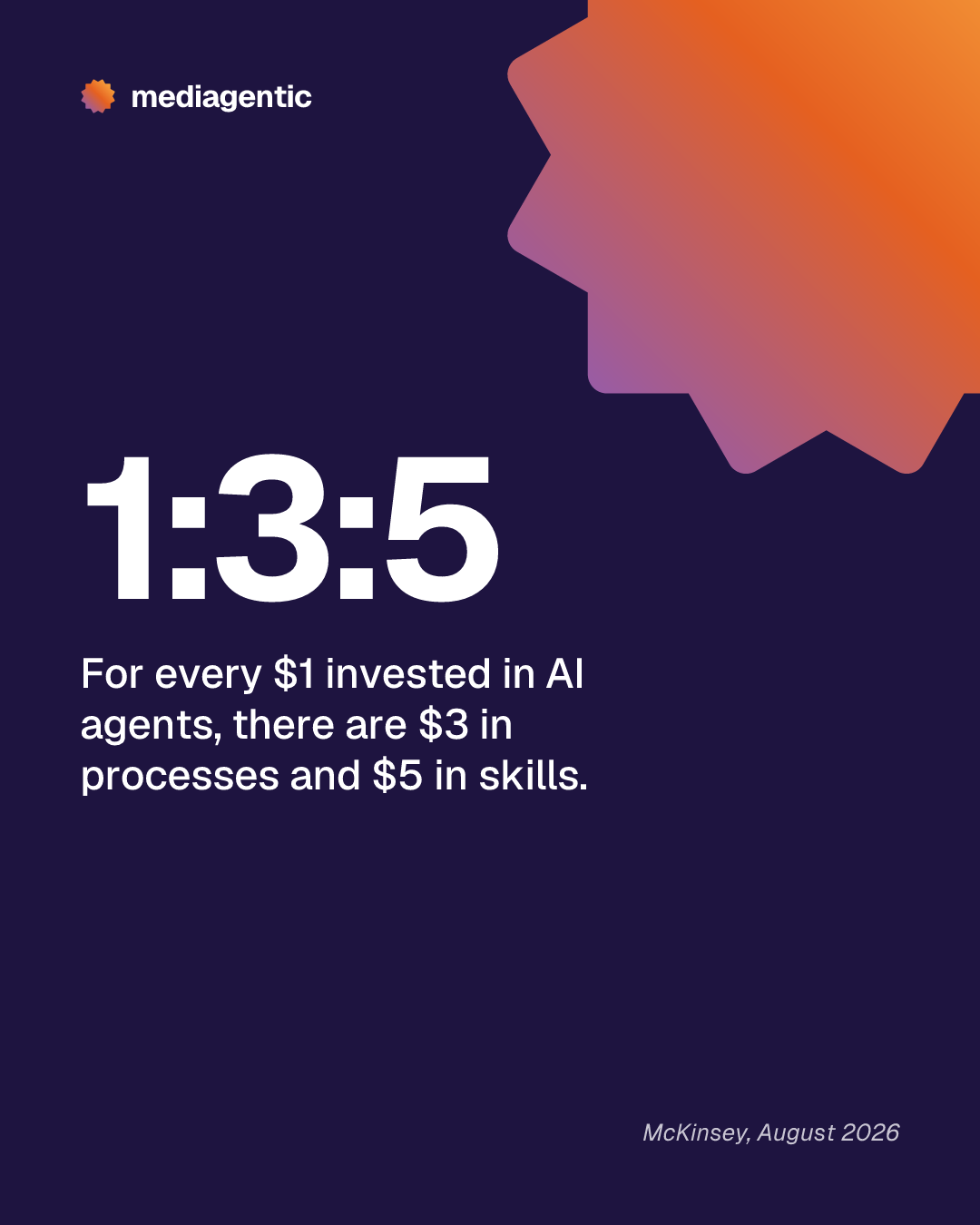
McKinsey puts a number on it: a successful agentic transformation puts 1 into technology, 3 into processes and 5 into skills. I launched mediagentic with no organization to transform, which leaves me free to explore, adjust and pivot.
In an August 2026 article, McKinsey sums up what it sees in successful agentic transformations with a ratio: for every dollar invested in technology, 3 go to process redesign and 5 to capability building and adoption. Most companies, the firm notes, invert the formula. What they get is imitation rather than adoption: workflows transformed on paper, tools "technically deployed but barely used".
The obstacles it describes are human: the fear of being found out, of being accountable for a decision you don't control, of the unknown, and of losing expertise built over years. Middle managers are the most exposed: 25% say they feel anxious about AI-related changes. McKinsey also warns that if metrics, incentives and decision rights still reward the old way of working, new habits won't last.
I have run agencies inside large groups. I know what that 3 and that 5 mean: job descriptions to rewrite, approval loops to undo, hourly billing that would have to go.
I launched mediagentic from scratch, bootstrapped, with no payroll, so with no existing organization to convert. The agents and the decision rules they apply were designed together from the start, around a strategist who decides. I have no one to reassure and no habits to unlearn, which lets me explore, adjust or pivot as soon as a method shows its limits.
For an SMB, it is also a way to escape the ratio. It doesn't need to rethink its organization to benefit from agents, because the 3 and the 5 are part of the service, with a one-off setup fee and then a fixed monthly fee.