Advantage+ doesn't target your audiences anymore. It reads your creative.
Since Andromeda and GEM, Meta picks the buyer from the creative signal, not from targeting. Advantage+ needs volume, CAPI and fresh creative. Automated, yes — for Meta, and in a silo.
Many advertisers still run Meta the way they did in 2019: detailed audiences, lookalikes, one ad set per segment. The system changed under their feet.
Under Advantage+, two engines now do the work. Andromeda, rolling out since late 2024, is a new ad retrieval engine that runs, according to Meta, on ten thousand times the model capacity of its predecessor. GEM, the Generative Ads Recommendation Model, then ranks the ads it retrieves. The adaptive ranking model announced in March 2026 routes each request to a model of the right size, with latency in the region of 100 milliseconds. What these systems read first is no longer your targeting: it is your creative. The video, the hook, the product shown decide who the ad is served to. Manual targeting has become a brake the algorithm works around.
The practical consequences, as practitioners measure them in the field. Advantage+ Sales needs volume: around 50 purchase events a week per campaign to exit the learning phase, 100 to be stable. The browser pixel now captures only about 40% of events; without the Conversions API, the algorithm learns on truncated data. And since creative has become the targeting, it has to be refreshed: three to five new concepts a month per €50,000 of spend, with fatigue signals to watch — CTR below 1.5%, CPM up 25% in a week, ROAS falling three days in a row.
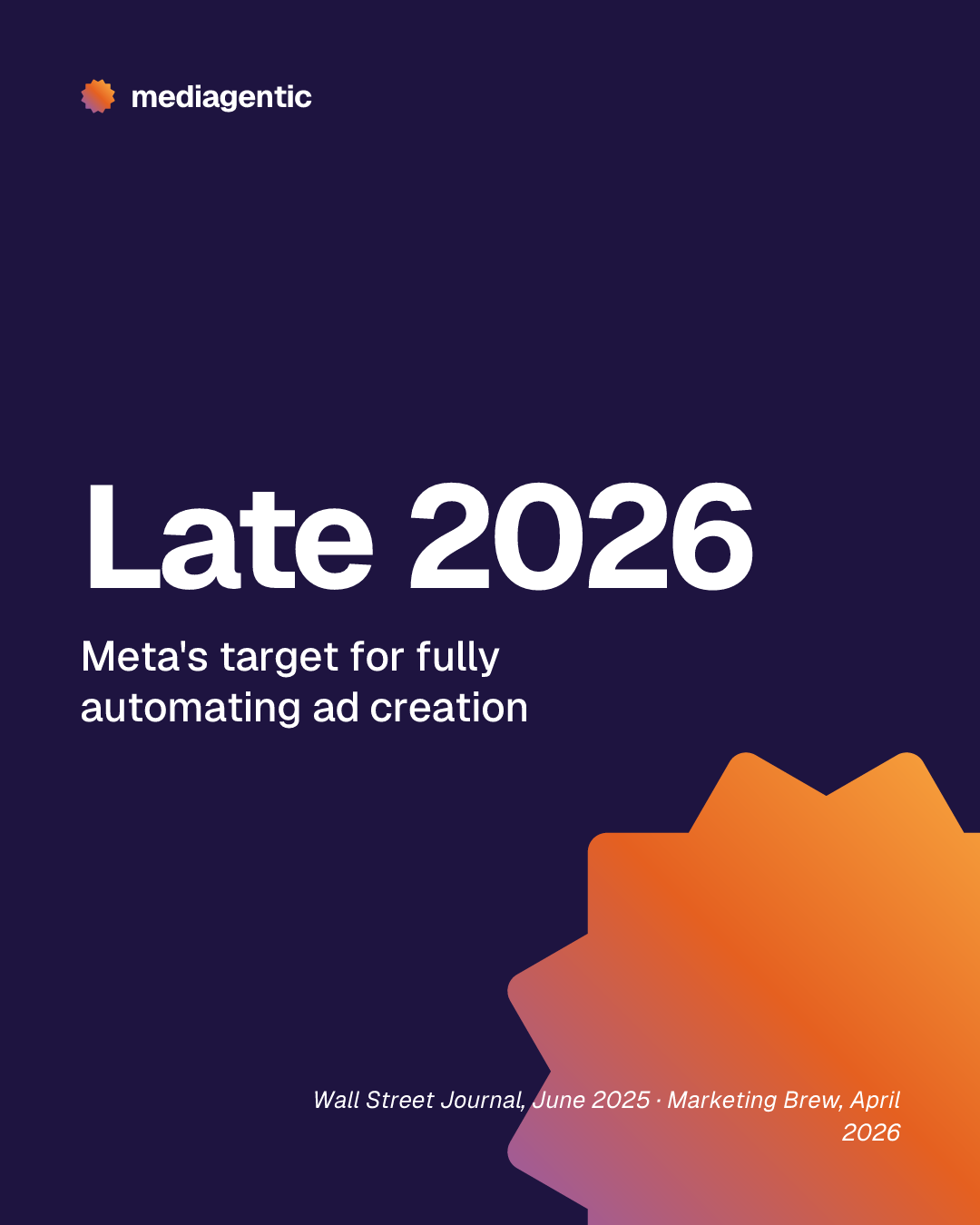
Meta has set the end of 2026 as its target for fully automating ad creation, according to the Wall Street Journal. More than 9 million small businesses already use at least one of its AI creative tools, according to its second-quarter 2026 results.
The principle is the same elsewhere. At Google, Performance Max and AI Max; at TikTok, Smart+. The advertiser provides a goal, a budget and creative; the algorithm picks the audience, the bid and the placement.
All of this is automated. But automated by Meta, for Meta, in a silo: platform ROAS over-credits the last click and underestimates the effect on brand search. Someone has to operate that automation with the ability to arbitrate across your whole media mix. That is a media agent's job. Not Meta's.